Why Viral LinkedIn Posts Aren't Getting Cited by AI (And What Is)
A new Semrush study reveals that virality doesn't equal AI citations. Discover the exact formula, ideal word counts, and why text formats outperform carousels in AI search.
SEOGEO Editorial
News Analysis
A massive shift is happening in how B2B buyers discover information. According to a new study analyzing 325,000 prompts across ChatGPT Search, Google AI Mode, and Perplexity, LinkedIn is now the second most-cited domain in AI search. It appears in 11% of all AI responses, beating out giants like Wikipedia and YouTube.
But what exactly makes an AI model choose your LinkedIn post as a trusted source? Semrush analyzed 89,000 unique LinkedIn URLs cited by AI, and the results shatter everything we thought we knew about social media algorithms.
The Formula for AI Citations
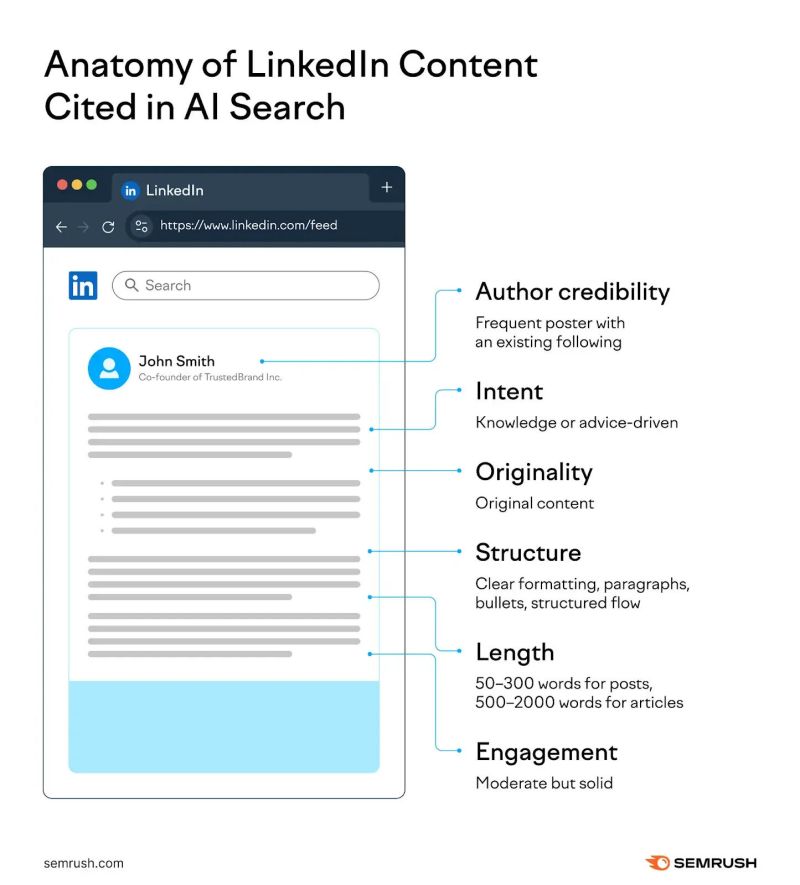
Here is the exact anatomy of a highly cited LinkedIn post:
- Post consistently: 75% of cited authors posted at least five times in the preceding four-week period.
- Focus on knowledge: Between 54% and 64% of cited posts focused on sharing practical advice rather than promotional content.
- Originality is mandatory: Approximately 95% of cited posts were original content; reshares barely register at just 5%.
- Keep it punchy: For standard feed posts, the sweet spot for citations is between 50 and 299 words.
- Virality doesn't matter: The median cited post had only 15 to 25 reactions and no more than one comment.
The Carousel Conundrum: Why Rich Media Lags Behind
If you spend any time on LinkedIn, you know that carousels and native videos are the primary growth levers for creators right now. So why didn't these formats dominate the citation study?
The answer comes down to Answer Engine Optimization (AEO) and how Large Language Models (LLMs) parse data. The study reveals that LinkedIn articles actually dominate AI citations, accounting for 50% to 66% of all cited LinkedIn content. Standard feed posts make up the next largest chunk at 15% to 28%.
Why do text articles win? Because they are longer, heavily structured, and easily indexable. When a user prompts an Answer Engine, the AI needs to scrape raw text, headings, and bullet points to synthesize a response. Carousels (which are often uploaded as PDF documents or image slides) and native video files are notoriously difficult for AI crawlers to "read" and extract direct quotes from.
While a highly visual 12-slide carousel might trigger the LinkedIn feed algorithm and get hundreds of likes, an AI bot cannot easily extract the text flattened into those images to use as a verified source.
The New B2B Playbook: Reach vs. Reference
This data forces a strategic fork in the road for founders and marketers looking to master the new AI SEO stack.
If your goal is immediate social reach and top-of-funnel brand awareness, keep producing carousels and videos. But if your goal is Generative Engine Optimization (GEO) and ensuring your brand is the definitive answer when buyers ask ChatGPT a question, you must incorporate text-heavy formats.
- Long-form Articles: Publish articles between 500 and 2,000 words. Structure them with clear H2s and H3s, and use an Article Schema Generator for your on-site content to mimic this indexability.
- Mid-length Posts: Write original text posts between 50 and 300 words that answer specific, niche questions directly.
- Semantic Overlap: The study found semantic similarity scores of 0.57 to 0.60 for LinkedIn content, meaning AI doesn't just link to your post; it echoes your exact meaning and terminology.
Stop chasing the viral feed, and start building a knowledge base. AI is evaluating your expertise right now.
Frequently Asked Questions
No. In fact, a recent study showed that the median cited LinkedIn post only had 15 to 25 reactions and no more than one comment. AI prioritizes relevance and expertise, not social popularity.
AI models rely on scraping and parsing text to synthesize answers. LinkedIn Articles are long, text-heavy, structured with headings, and easily indexable. Carousels are typically PDFs or image files, making it difficult for an AI to extract direct text and quote the author.
For standard feed posts, the ideal length for AI citations is between 50 and 299 words. For full LinkedIn Articles, the sweet spot is between 500 and 2,000 words.