Google's Official GEO Advice Just Dropped (And It Looks A Lot Like Traditional SEO)
Google just released official guidance on Generative Engine Optimization, debunking popular 'AI hacks'. The real secret to AI visibility? Mastering the traditional on-page SEO checklist.
SEOGEO Intelligence
SEOGEO Intelligence

The digital marketing world is currently flooded with panic regarding Generative Engine Optimization (GEO). Opportunistic "gurus" are selling secret hacks, weird markdown files, and robotic writing formulas, claiming you need to fundamentally break your website to appease AI bots.
Google just officially told them to stop.
In a newly published guidance update, Google systematically dismantled the biggest myths surrounding AI search optimization. And in doing so, they revealed a truth that we at SEOGEO have been preaching for months: the best way to optimize for the future of AI search is to master the fundamentals of traditional SEO.
Google's Official AI Myth-Busting
Let's look at exactly what Google published regarding what you do not need to do for generative AI search visibility.
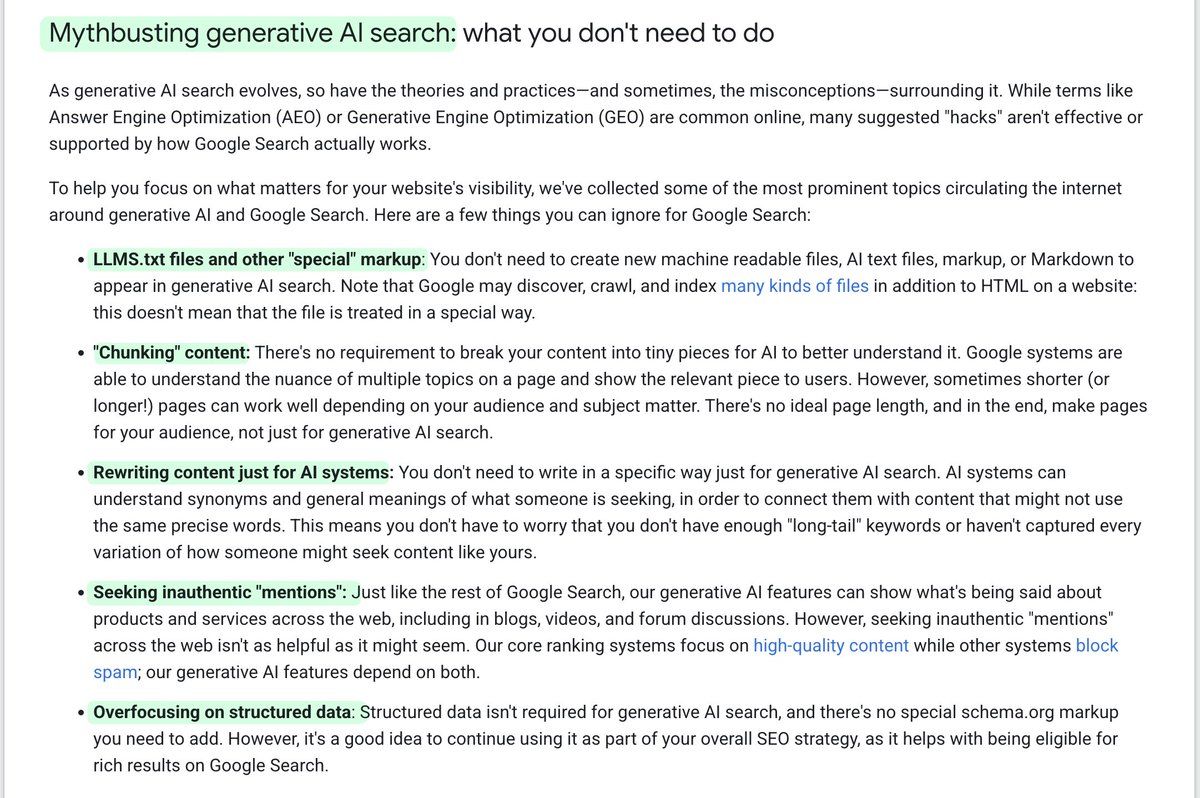
According to Google's official documentation, here is what is entirely unnecessary:
- No "Special" Files Needed: You do not need to create `llms.txt` files, machine-readable text files, or special markdown just to appease AI.
- No "Chunking" Required: You don't need to break your content into unnatural, bite-sized pieces. Google's systems can parse long-form nuance perfectly fine.
- No Robotic Rewriting: You do not need to write specifically for AI systems or worry about capturing every single long-tail keyword variation. AI understands semantics and synonyms.
- Fake Mentions Are Dead Weight: Seeking inauthentic mentions on third-party sites doesn't fool the AI; it relies on high-quality content signals, just like standard ranking algorithms.
- Don't Over-Focus on Structured Data: There is no secret "AI Schema." You should use schema for overall SEO, but you don't need to reinvent it for generative AI.
The Irony: Good GEO is Just Great SEO
If you strip away all the fake hacks and pseudo-science surrounding Generative Engine Optimization, what are you left with? You are left with building a fast, well-structured, authoritative website designed for human readers.
In other words, you are left with the traditional on-page SEO checklist.
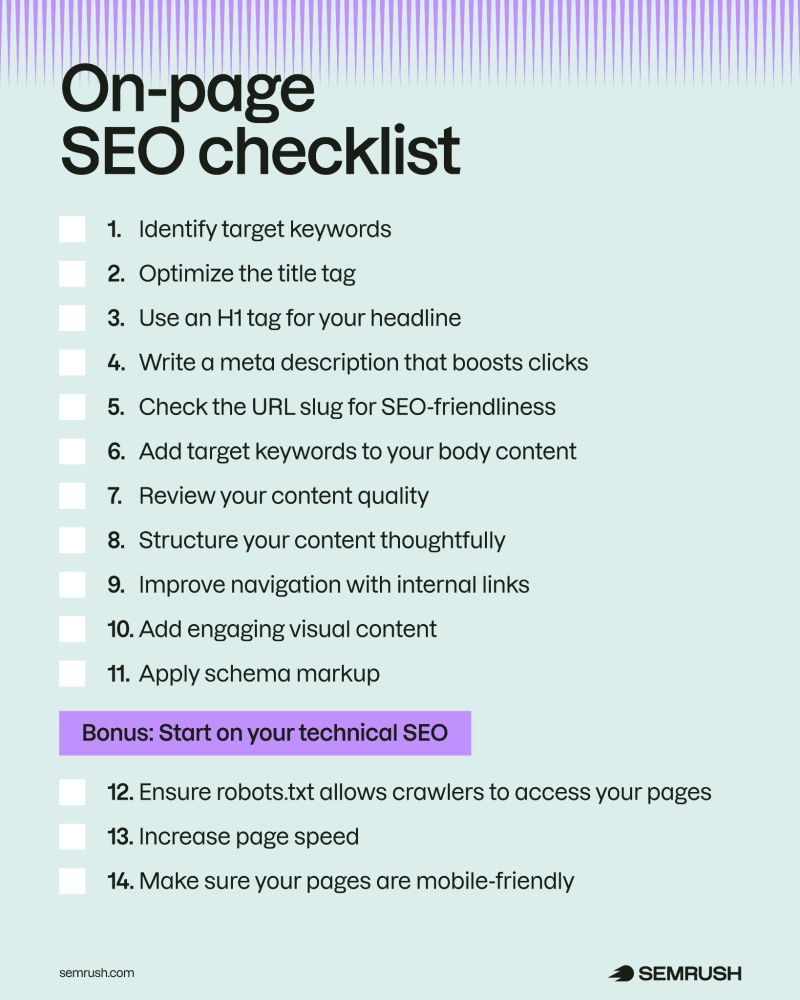
Look at the foundational Semrush checklist above. Notice how perfectly it aligns with what Google actually wants for its AI Overviews:
- "Use an H1 tag and structure content thoughtfully" (Points 3 & 8): Google doesn't want you to "chunk" your text into robotic snippets, but they do need logical architecture. Proper heading hierarchies (H1, H2, H3) provide the semantic structure LLMs use to understand context.
- "Review your content quality" (Point 7): Google explicitly stated that their generative AI features depend heavily on their core ranking systems blocking spam and surfacing high-quality content. You cannot trick an AI with thin content.
- "Apply schema markup" (Point 11): While Google said not to over-obsess over "AI-specific" schema, they explicitly noted that standard schema.org markup is still highly recommended as part of your overall SEO strategy to be eligible for rich results.
- "Start on your technical SEO" (Points 12-14): Page speed, mobile-friendliness, and clean `robots.txt` files ensure that Google's complex AI crawlers can actually access and process your information without wasting crawl budget.
The Strategy Moving Forward
The convergence is clear. The same signals that tell Google's traditional algorithm your page is authoritative are the exact same signals Google's AI models use to determine if you are worthy of citation.
The SEOGEO Verdict
Stop trying to optimize for a bot that doesn't exist. There is no magic `.txt` file that will force ChatGPT or Google AI Overviews to cite you. Build your brand authority, answer user questions comprehensively, and execute flawless technical on-page SEO. That is the only defensible GEO strategy.
The brands that win in the generative era won't be the ones using gimmicky coding hacks. They will be the ones who master the fundamentals better than their competitors.
Analysis by SEOGEO Intelligence
SEOGEO is the premier destination for digital marketers looking to decode Generative Engine Optimization, AI Search algorithms, and the future of online discovery.
Read more articles →Frequently Asked Questions
No. Google officially stated that there is no need to create specialized machine-readable files, Markdown, or `llms.txt` files to appear in generative AI search. Standard, well-structured HTML is exactly what their systems are designed to process.
No. Google explicitly debunked the "chunking" myth. Their AI systems are fully capable of understanding the nuance of multiple topics on a single long-form page. Write for your audience's needs, not to arbitrarily chop up content for a bot.